
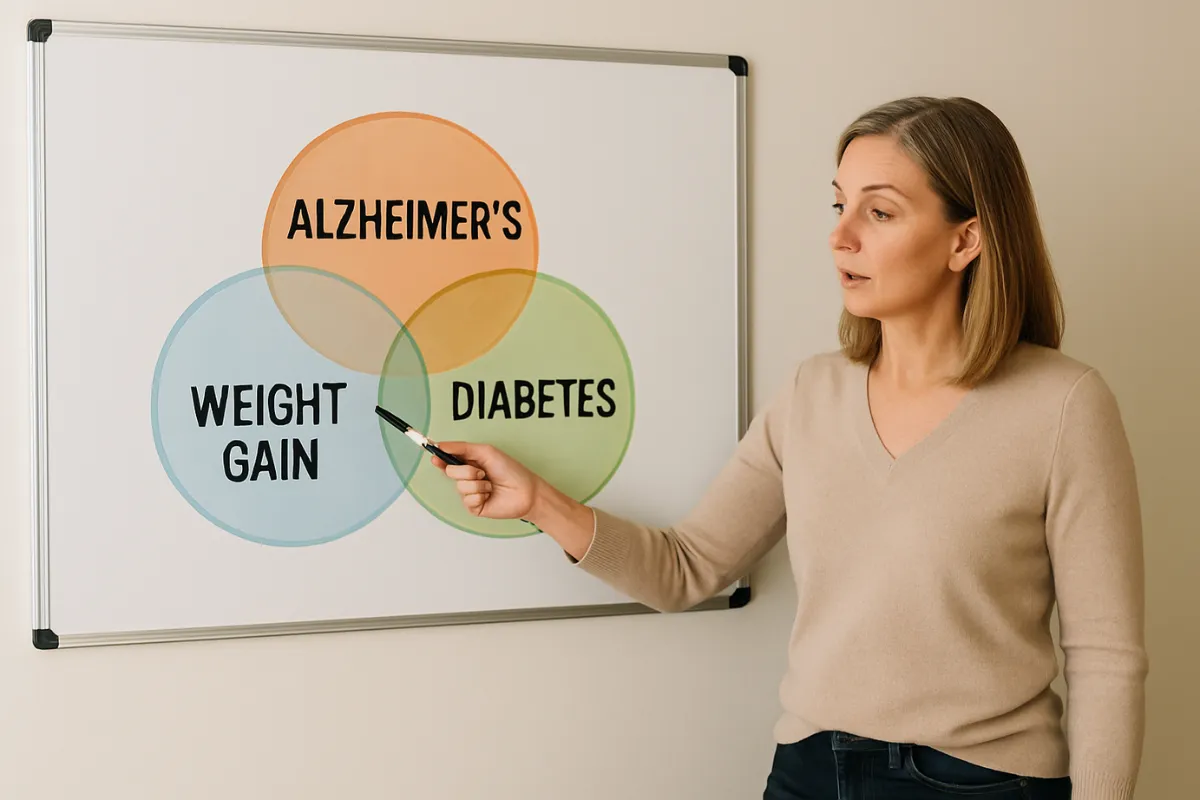
Do This One Thing to Prevent Alzheimer's, Diabetes & Weight Gain
I'll never forget the years I spent as a caregiver for a family member with Alzheimer's. Watching someone you love slowly fade is heart-breaking.
And I'll never forget the decades I spent fighting my own weight from age 10 to my mid-40s. Trying every diet. Counting every calorie. Pushing myself harder and harder. Nothing lasted.
For years, I thought these were two separate struggles. One was genetics. One was my lack of willpower.
I was wrong about both.
Here's what I discovered: Alzheimer's, diabetes, and weight gain all share a common thread elevated insulin caused by high blood sugar.
And here's the empowering part: you have more control over this than you've been told.
If you've been struggling with weight despite trying everything, worrying about your brain health, or feeling frustrated by your blood sugar numbers, I want you to know something: your body isn't broken. It's just out of balance.
Let me show you what I've learned.
What I Discovered That Changed Everything
Here's what opened my eyes: only 7% of Americans are metabolically healthy.¹
That means 93% of us you, me, our friends, our family have some level of issues with blood sugar, blood pressure, cholesterol, or waistline. These aren't separate problems. They're all connected.
So what is metabolic health? It's actually pretty simple. It means your body is doing what it's supposed to do with the food you eat. Your blood sugar stays stable. Your blood pressure and cholesterol are in normal ranges. Your waistline is healthy. It's a sign your body is working efficiently instead of struggling.
But when blood sugar stays elevated, your body releases insulin to bring it down. High blood sugar means high insulin. And high insulin signals your body to store fat. Over time, this creates a vicious cycle.
Now here's something most people don't know something I didn't know for years: your skeletal muscles are responsible for absorbing about 80% of the glucose you eat.²
Your muscles act like a sponge for blood sugar. But when blood sugar is chronically high, it actually triggers muscle loss. Less muscle means less blood sugar control, which leads to more muscle loss. It's a devastating cycle.
And for us women? This matters even more. After age 30, we naturally start losing muscle mass. After 50, we lose 1% per year.³ When you add chronic high blood sugar to the equation, that muscle loss accelerates and with it, your body's ability to regulate blood sugar diminishes.
Here's what really got my attention: researchers now call Alzheimer's "Type 3 Diabetes."⁴
When your brain becomes resistant to insulin, it can't use glucose for energy properly. That leads to cognitive decline and memory loss. This isn't just about your waistline. This is about your brain. Your future. Your ability to show up for your purpose.
Why You're Not Failing Your Approach Is
I know how discouraging it feels. You've tried so many things. You've worked so hard. And yet nothing seems to stick.
As a registered nurse for over 30 years, I've sat with countless women who felt exactly the same way. Exhausted. Frustrated. Ready to give up.
And here's what I've learned: it's not your fault.
Most weight loss approaches focus heavily on food and exercise. But they ignore the other critical factors that profoundly affect your blood sugar and metabolism like sleep quality, stress levels, toxin exposure, and even your mindset.
When you don't address all six areas of wellness (nutrition, sleep, stress, movement, detox, and mindset), you end up feeling discouraged. You blame yourself. You think you just need more discipline or willpower.
But here's the truth: your body isn't broken. It's just out of balance.
And when you're trying to do everything perfectly while also caring for your family, managing your responsibilities, and trying to show up for your calling it's overwhelming. That overwhelm becomes part of the problem, raising your cortisol, disrupting your sleep, and keeping your blood sugar on a rollercoaster.
Here's What Happens When We Ignore the Blood Sugar Connection
I've seen what happens when blood sugar imbalance goes unaddressed. I saw it in my patients for three decades. I experienced it myself during all those years I struggled with my weight.
Your brain health starts to decline. Insulin resistance in the brain increases your risk for Alzheimer's and dementia. Memory issues and brain fog get worse. Your energy plummets from constant blood sugar swings fatigue, anxiety, and mood instability become your new normal. You feel tired all the time, no matter how much you sleep.
Muscle loss accelerates, and without adequate muscle, your metabolism slows down. Weight loss becomes even harder. You feel weaker. Chronic inflammation increases throughout your body, creating systemic inflammation that contributes to autoimmune conditions, joint pain, and accelerated aging.
And eventually, diabetes becomes inevitable. What starts as occasional blood sugar spikes progresses to insulin resistance, then prediabetes, and finally type 2 diabetes.
Every day you spend just managing symptoms instead of healing the root cause is another day your body stays stuck in survival mode. And the longer you wait, the harder the imbalance becomes to reverse.
The One Thing That Transformed My Health
So here's what I want you to know. If there's only one thing you take from this article, let it be this:
Get rid of processed foods and eat whole foods from a farm, not a factory.
This is the foundation. Everything else builds on this one change.
Here's why: processed foods are designed to spike your blood sugar. They're loaded with added sugars, refined carbs, and inflammatory oils. When your blood sugar goes up, it comes down and you get hungry again. This keeps you on a cycle of eating and being hungry all day long.
And here's the thing: that's not an accident. That's how they're made. Food companies want you on this cycle so you keep buying their products.
Research shows that every 10% increase in processed food consumption raises your risk of death by 14%.⁵ And processed foods can add about 500 extra calories per day to your diet without you even realizing it.⁶
That cycle wreaks havoc on your brain, your metabolism, and your entire body.
Whole foods are different. They come from a farm, not a factory. They don't have an ingredient list because they ARE the ingredient. Vegetables. Fruits. Quality proteins. Healthy fats. Nuts. Seeds. Legumes.
When you eat whole foods, your blood sugar stays stable. Your insulin stays low. Your body stops storing fat and starts burning it.
This one change this foundational shift transformed my health in my mid-40s. And I've watched it transform the health of hundreds of women I've worked with since.
Simple Strategies That Make a Real Difference
Once you've committed to whole foods, here are the strategies that made all the difference for me:
Start your day with a savory breakfast
I know, I know. Toast and cereal are easy. But they set you up for blood sugar crashes all day long.
I remember the day I realized my mid-morning "anxiety" was actually my blood sugar crashing from the toast I'd eaten for breakfast. My heart would race. I'd feel jittery and unfocused. I thought something was wrong with me. Turns out, it was just my blood sugar on a rollercoaster.
Instead, try eggs with vegetables, Greek yogurt with nuts and seeds, or even leftover dinner. A protein-rich breakfast sets your blood sugar tone for the entire day and keeps your insulin steady. Once I made this one change, those "anxiety" episodes disappeared.
Use apple cider vinegar before meals
This one surprised me. Taking one tablespoon of apple cider vinegar in water before a meal can blunt your blood sugar spike by about 30%.⁷ If you don't have apple cider vinegar, lemon water helps too (though not quite as much).
Eat in the right order
Eat your vegetables first, then your protein, then your carbs. This simple shift slows down the digestion of carbohydrates and prevents a sharp blood sugar spike.⁸
Never eat naked carbs
This is my golden rule. Never, never, never eat carbs by themselves. Always pair them with protein, fat, and fiber.
What are naked carbs? Fruit alone. Crackers alone. Toast alone. Any carb without protein, fat, and fiber hits your bloodstream fast and spikes your blood sugar hard.
Instead, pair your carbs: apple with almond butter, crackers with cheese, toast with eggs and avocado. Protein, fat, and fiber slow digestion and prevent the spike.
Walk for 10 minutes after meals
Remember, your muscles absorb 80% of the glucose you eat. When you move them, you help your body process blood sugar naturally with less insulin release.⁹ Just 10 minutes makes a huge difference.
Prioritize healthy fats for brain health
Your brain is 60% fat by weight.¹⁰ It needs whole food fats like MCT oil, coconut oil, olive oil, and avocado oil to function properly. These fats also keep you full and keep your blood sugar steady.
Think about your plate
Half your plate should be non-starchy vegetables. A quarter should be quality protein (grass-fed, wild-caught, pasture-raised). A quarter should be healthy carbs with healthy fat, like sweet potatoes with butter or quinoa with olive oil. This combination prevents insulin spikes and supports fat burning.
Try a fasting window
Fasting for 12-16 hours overnight between dinner and breakfast helps lower insulin and puts your body into fat-burning mode. Listen to your body some women feel great at 12 hours, others at 16. It's not one-size-fits-all.
Why All Six Areas of Wellness Matter
Here's what I wish I'd known earlier: you can't just focus on food and movement.
At Inspired Well, I use what I call the Wheel of Wellness framework. Blood sugar doesn't exist in isolation. It's affected by all six areas:
Nutrition – What you eat and when you eat it
Sleep – Poor sleep raises cortisol, which raises blood sugar
Stress – Chronic stress keeps cortisol and blood sugar elevated
Movement – Your muscles absorb glucose and increase metabolism
Detox – Toxins disrupt your hormones and metabolism
Mindset – Your beliefs and identity shape every habit you create
When you address all six areas together, that's when true transformation happens. Unfortunately, the weight loss world focuses heavily on food and movement and leaves out the other four areas. That's why so many women end up discouraged.
When you bring all six together, you don't just lose weight. You restore balance to your entire system. You experience true healing.
What Changes When Your Blood Sugar Is Balanced
When you stabilize your blood sugar naturally, everything shifts.
Your brain stays sharp. You protect yourself from cognitive decline and Alzheimer's risk. Your energy soars. No more afternoon crashes. No more relying on caffeine just to get through the day. Your anxiety calms. Those blood sugar crashes that felt exactly like anxiety attacks disappear when your blood sugar is stable. Your mood becomes stable too.
Your weight comes off naturally. When insulin is low, your body releases fat instead of storing it. Your body feels strong. You preserve muscle mass and build metabolic resilience.
This isn't a quick fix. It's a transformation. And when you ground it in your identity in Christ remembering that you're created in God's image, deeply loved, and lacking in nothing the journey becomes one of grace, not guilt.
Where You Can Start Today
I know this might feel like a lot. So let me make it really simple.
Just pick one thing this week. One change. One shift.
Maybe you swap out one processed food for a whole food. Maybe you start your day with a savory breakfast. Maybe you commit to never eating naked carbs. Maybe you take a 10-minute walk after dinner. Maybe you try the apple cider vinegar.
Whatever feels doable that's where you start.
When that one thing becomes easier, then you add another.
This is about progress, not perfection. Your body was created to heal. You're created in the image of God. And when you give your body more of what it needs and less of what it doesn't, something amazing happens.
Your blood sugar improves dramatically. Your body is nourished at a cellular level. Health is optimized. And weight loss becomes a natural by-product.
Give yourself some grace. Take it one step at a time. Small changes over time lead to big transformation.
Take the First Step Toward Healing
If you're ready to stop the cycle and start healing from within, I'm here to support you at Inspired Well.
My Foundations of Wellness-Based Weight Loss program guides you step-by-step through all six areas of the Wheel of Wellness. You'll learn how to balance your blood sugar, optimize your health, and release the weight naturally grounded in your identity in Christ.
👉 Join the waitlist today: https://inspiredwell.org/waitlist
📥 Download the FREE Wheel of Wellness assessment: https://inspiredwell.org/wheel
Take the first step toward feeling better naturally. Your body was designed to heal. Let's help it thrive.
Disclaimer: The discussion of these strategies is for educational purposes only. Please consult a qualified medical professional who knows your personal health history before making dietary or lifestyle changes.References
Araújo J, Cai J, Stevens J. Prevalence of Optimal Metabolic Health in American Adults: National Health and Nutrition Examination Survey 2009–2016. Metab Syndr Relat Disord. 2019;17(1):46-52. https://www.liebertpub.com/doi/10.1089/met.2018.0105
DeFronzo RA, Tripathy D. Skeletal muscle insulin resistance is the primary defect in type 2 diabetes. Diabetes Care. 2009;32 Suppl 2(Suppl 2):S157-S163. https://pubmed.ncbi.nlm.nih.gov/19875544/
Walston JD. Sarcopenia in older adults. Curr Opin Rheumatol. 2012;24(6):623-627. https://pubmed.ncbi.nlm.nih.gov/22955023/
de la Monte SM, Wands JR. Alzheimer's disease is type 3 diabetes-evidence reviewed. J Diabetes Sci Technol. 2008;2(6):1101-1113. https://pubmed.ncbi.nlm.nih.gov/19885299/
Schnabel L, Kesse-Guyot E, Allès B, et al. Association Between Ultraprocessed Food Consumption and Risk of Mortality Among Middle-aged Adults in France. JAMA Intern Med. 2019;179(4):490-498. https://pubmed.ncbi.nlm.nih.gov/30742202/
Hall KD, Ayuketah A, Brychta R, et al. Ultra-Processed Diets Cause Excess Calorie Intake and Weight Gain. Cell Metab. 2019;30(1):67-77.e3. https://pubmed.ncbi.nlm.nih.gov/31105044/
Johnston CS, Steplewska I, Long CA, Harris LN, Ryals RH. Examination of the antiglycemic properties of vinegar in healthy adults. Ann Nutr Metab. 2010;56(1):74-79. https://pubmed.ncbi.nlm.nih.gov/20068289/
Shukla AP, Iliescu RG, Thomas CE, Aronne LJ. Food Order Has a Significant Impact on Postprandial Glucose and Insulin Levels. Diabetes Care. 2015;38(7):e98-e99. https://pubmed.ncbi.nlm.nih.gov/26106234/
Colberg SR, Zarrabi L, Bennington L, et al. Postprandial walking is better for lowering the glycemic effect of dinner than pre-dinner exercise in type 2 diabetic individuals. J Am Med Dir Assoc. 2009;10(6):394-397. https://pubmed.ncbi.nlm.nih.gov/19560716/
Chang CY, Ke DS, Chen JY. Essential fatty acids and human brain. Acta Neurol Taiwan. 2009;18(4):231-241. https://pubmed.ncbi.nlm.nih.gov/20329590/


